What your child learns
- Explain the difference between weather (short-term) and climate (long-term average).
- Name the main weather variables: temperature, precipitation, humidity, wind and air pressure.
- Describe the main climate zones and what causes them.
- Read a simple climate graph.
NGSS MS-ESS2-5 NGSS MS-ESS2-6
People often mix up weather and climate, even in the news. A simple way to remember: weather is your mood today; climate is your personality. Today you might be grumpy, but over years you are usually cheerful. Weather changes hour to hour; climate describes what is normal for a place over decades.
Weather: the atmosphere right now
Meteorologists measure five main variables.
Example 1: Reading a weather report
- Temperature: 18 °C (64 °F), measured with a thermometer.
- Precipitation: 5 mm of rain, measured with a rain gauge.
- Humidity: 80%, how much water vapor is in the air.
- Wind: 15 km/h from the west, from an anemometer and wind vane.
- Air pressure: falling, measured with a barometer, which often means a storm is coming.
Climate: the long-term pattern
Climate is the average weather of a place over about 30 years.
Example 2: Two cities in January
- Miami, Florida averages about 20 °C (68 °F) in January.
- Minneapolis, Minnesota averages about −9 °C (16 °F) in January.
- Both can have an unusual day, but their climates are very different because of their latitude.
Example 3: What sets a climate
- Latitude: places near the Equator get more direct sunlight and are warmer.
- Distance from the ocean: oceans heat and cool slowly, so coastal places have milder climates.
- Elevation: air gets colder higher up, so mountains are cooler.
- Ocean currents and winds move heat around the planet.
Example 4: Climate zones
- Tropical: near the Equator, hot all year, often very rainy.
- Temperate: the middle latitudes, with four seasons (most of the United States and Europe).
- Polar: near the poles, cold all year.
- Deserts can form in many zones wherever there is very little precipitation.
See where these zones fall with our continent facts.
Practice
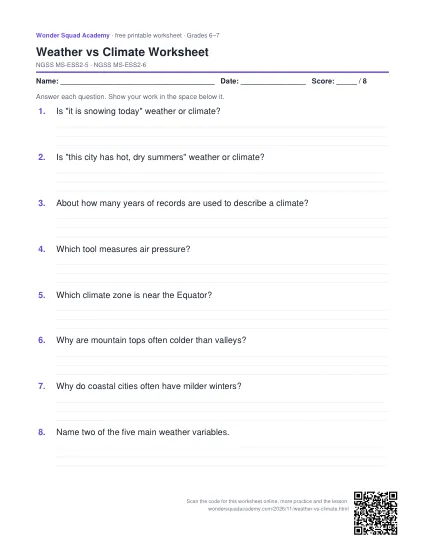
- Is "it is snowing today" weather or climate?
- Is "this city has hot, dry summers" weather or climate?
- About how many years of records are used to describe a climate?
- Which tool measures air pressure?
- Which climate zone is near the Equator?
- Why are mountain tops often colder than valleys?
- Why do coastal cities often have milder winters?
- Name two of the five main weather variables.
Show answers
- Weather
- Climate
- About 30 years
- A barometer
- Tropical
- Air is colder at higher elevations.
- The ocean warms and cools slowly, which keeps temperatures milder.
- Any two of: temperature, precipitation, humidity, wind, air pressure
📄 Weather vs Climate Worksheet.pdf
⬇ Download PDF🖨 Open & printWorksheet page
🔒 Free parent sign-in (Google or Microsoft) to download. Why?
Common mistakes and quick fixes
- Using one day or one season as proof about climate. Climate needs decades of data.
- "Deserts are always hot." A desert is defined by low precipitation; Antarctica is a cold desert.
- Mixing up humidity and precipitation. Humidity is water vapor in the air; precipitation is water falling as rain, snow, sleet or hail.
Try it at home
Start a two-week weather station. Each day at the same time, record the temperature (an outdoor thermometer or a weather app), whether it rained, and the wind. At the end, compare your averages with your city's climate averages online. Was this a typical two weeks?
Related lessons: the water cycle, latitude and longitude, and all Grades 6–7 lessons.
Questions parents ask
What is the simplest way to explain weather vs climate?
Weather is what you get today; climate is what you expect over many years. A rainy day in the desert is weather. The fact that the desert gets very little rain most years is its climate.
How long do scientists look at to describe a climate?
Usually 30 years of weather records. Averaging over that long smooths out unusual days and years.
Can one cold winter prove the climate is not warming?
No. One season is weather. Climate change is about long-term trends in averages over decades, across the whole planet.