What your child learns
- Read and evaluate expressions with whole-number exponents, such as 3² and 2⁴.
- Use the order of operations to evaluate expressions with parentheses, exponents and all four operations.
- Evaluate expressions with a variable, such as 3x² when x = 4.
Common Core 6.EE.A.1 Common Core 6.EE.A.2
Is 2 + 3 × 4 equal to 20 or to 14? Mathematicians agreed on an order so that everyone gets the same answer: 14. In 6th grade, expressions get longer and add a new tool, the exponent, so knowing the order matters more than ever.
Exponents first
Example 1: Reading exponents
- In 5³, 5 is the base and 3 is the exponent.
- The exponent says how many times to use the base as a factor: 5³ = 5 × 5 × 5.
- 5 × 5 = 25, and 25 × 5 = 125.
Special names: 5² is "5 squared" (25) and 5³ is "5 cubed" (125).
The order of operations
Work in this order: 1. Parentheses (grouping symbols) → 2. Exponents → 3. Multiplication and division, left to right → 4. Addition and subtraction, left to right.
Example 2: 18 − 4 × 3 + 2
- No parentheses or exponents. Multiply first: 4 × 3 = 12, so the expression becomes 18 − 12 + 2.
- Now add and subtract left to right: 18 − 12 = 6, then 6 + 2 = 8.
Example 3: (6 + 2)² ÷ 4
- Parentheses: 6 + 2 = 8.
- Exponent: 8² = 64.
- Divide: 64 ÷ 4 = 16.
Example 4: Evaluate 3x² + 5 when x = 4
- Replace x with 4: 3 × 4² + 5.
- Exponent first: 4² = 16 (only the 4 is squared, not the 3).
- Multiply: 3 × 16 = 48. Add: 48 + 5 = 53.
Practice
- 2⁴ = ?
- 7² = ?
- 10 + 6 ÷ 2 = ?
- (10 + 6) ÷ 2 = ?
- 20 − 3 × 5 = ?
- 4 + 3² × 2 = ?
- 24 ÷ 6 × 2 = ?
- Evaluate 2x³ when x = 3.
- Evaluate (y − 1)² when y = 6.
Show answers
- 16
- 49
- 13
- 8
- 5
- 22
- 8
- 54
- 25
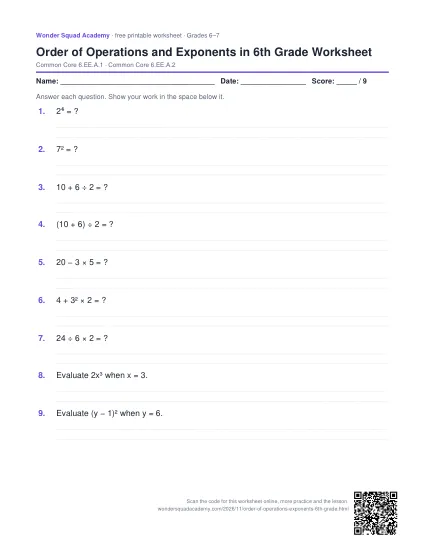
📄 Order of Operations and Exponents in 6th Grade Worksheet.pdf
⬇ Download PDF🖨 Open & printWorksheet page
🔒 Free parent sign-in (Google or Microsoft) to download. Why?
Common mistakes and quick fixes
- Treating an exponent as multiplication (2³ = 6). Write it out: 2 × 2 × 2 = 8.
- "Multiplication always comes before division." They are partners: work left to right. 24 ÷ 6 × 2 is 4 × 2 = 8, not 24 ÷ 12 = 2.
- Squaring the coefficient too (3x² with x = 4 → 12² = 144). The exponent belongs only to the x.
Try it at home
Play target number. Roll four dice (or pick four number cards) and choose a target, such as 24. Your child uses the numbers once each, with any operations and parentheses, to hit the target, then writes the expression and checks it with the order of operations. Example with 2, 3, 4 and 6: 6 × 4 × (3 − 2) = 24. Can you find another way?

This guide matches the expressions unit in Level Up Math, Grade 6 (coming January 2027). Next, try the Algebra Basics video lesson, or browse all Grades 6–7 lessons.
Questions parents ask
Is PEMDAS the right way to remember the order of operations?
PEMDAS (Parentheses, Exponents, Multiplication and Division, Addition and Subtraction) is a helpful reminder, but it hides one important rule: multiplication and division are done together from left to right, and so are addition and subtraction. Multiplication does not always come before division.
What does 2³ mean?
It means 2 multiplied by itself 3 times: 2 × 2 × 2 = 8. The small raised number is the exponent and tells how many times the base is used as a factor. It does not mean 2 × 3.
Why do we need an order of operations?
So that everyone gets the same answer. Without a rule, 2 + 3 × 4 could be 20 or 14. The agreed order gives 14.