What your child learns
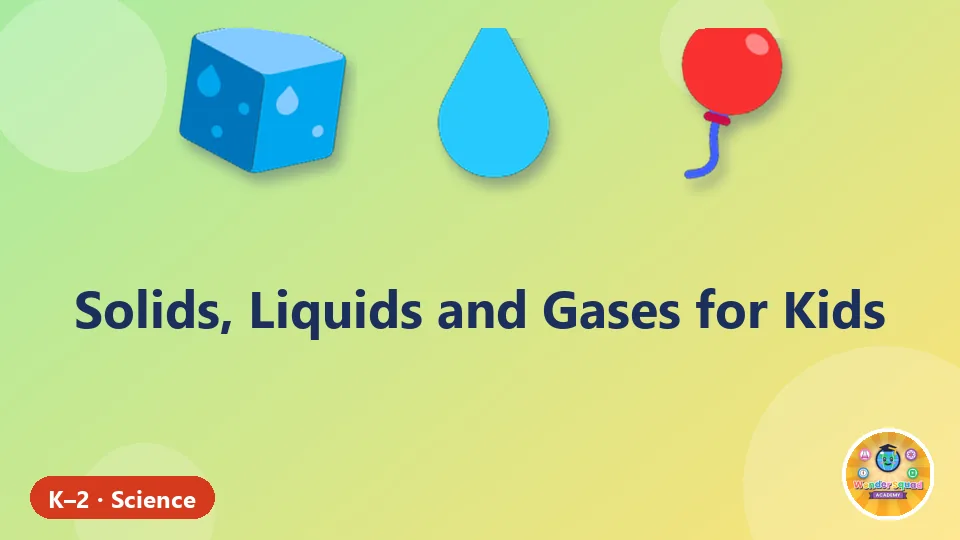
- Name the three states of matter: solid, liquid and gas.
- Describe each state: solids keep their shape, liquids take the shape of their container, gases spread out to fill a space.
- Explain that heating and cooling can change matter from one state to another, and that some changes can be reversed.
NGSS 2-PS1-1 NGSS 2-PS1-4
Everything around us is made of matter: anything that takes up space. Matter comes in three main forms, called states. A great way to learn them is with water, because it can be all three!
The three states
Example 1: Solids
- A solid keeps its own shape and size.
- Put a block in a bowl or a cup: it stays a block.
- Examples: ice, a rock, a toy car, a pencil.
Example 2: Liquids
- A liquid flows and takes the shape of its container.
- Pour juice into a tall glass and then a flat plate: the juice changes shape, but there is the same amount.
- Examples: water, milk, juice, honey.
Example 3: Gases
- A gas spreads out to fill whatever space it is in.
- Blow into a balloon: the air fills the whole balloon.
- Most gases are invisible, like air. Examples: air, steam, the gas inside a balloon.
Changing states
Example 4: Water changes
- Heat ice and it melts into liquid water (solid → liquid).
- Put water in the freezer and it freezes into ice (liquid → solid).
- Boil water and it turns into water vapor, a gas (liquid → gas). This is a change you can see in the water cycle.
Melting and freezing can be reversed: ice → water → ice again.
Practice
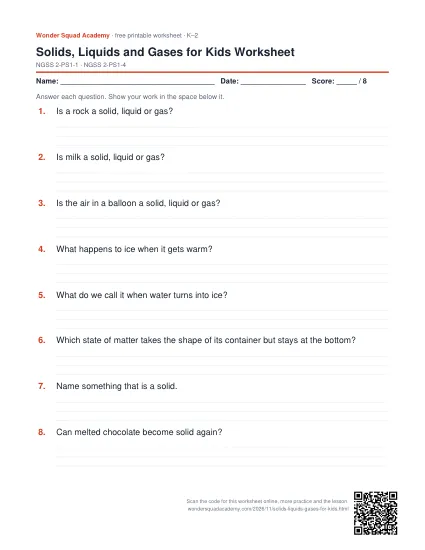
- Is a rock a solid, liquid or gas?
- Is milk a solid, liquid or gas?
- Is the air in a balloon a solid, liquid or gas?
- What happens to ice when it gets warm?
- What do we call it when water turns into ice?
- Which state of matter takes the shape of its container but stays at the bottom?
- Name something that is a solid.
- Can melted chocolate become solid again?
Show answers
- Solid
- Liquid
- Gas
- It melts into water.
- Freezing
- A liquid
- Any solid, such as a book, a spoon or a block
- Yes, if it cools down.
📄 Solids, Liquids and Gases for Kids Worksheet.pdf
⬇ Download PDF🖨 Open & printWorksheet page
🔒 Free parent sign-in (Google or Microsoft) to download. Why?
Common mistakes and quick fixes
- "Sand is a liquid because it pours." Each grain of sand is a tiny solid that keeps its shape.
- "Gases aren't matter because we can't see them." Air takes up space: a blown-up balloon proves it.
- "Melting makes things disappear." The ice became water; the matter is still there.
Try it at home
Do an ice cube race. Put ice cubes in different places: a sunny window, the kitchen counter, a bowl of warm water and the fridge. Guess which will melt first, then check every 10 minutes. Afterward, put the water back in the freezer to show the change can be undone.
Keep exploring: the water cycle, living and nonliving things, or all K–2 lessons.
Questions parents ask
What is matter?
Matter is anything that takes up space and has weight (mass). Your toys, water and even the air you breathe are all matter.
Is water always a liquid?
No. Water can be a solid (ice), a liquid (water) or a gas (water vapor), depending on how warm or cold it is.
Can every change be undone?
Some can. Ice can melt and then freeze again. Other changes cannot be undone, like baking a cake or burning wood.