What your child learns
- Explain that a habitat is a home that gives an animal food, water, shelter and space.
- Name and describe six habitats: forest, ocean, desert, grassland, rainforest and Arctic.
- Match animals to the habitat they live in and say one way each animal fits its home.
NGSS K-ESS3-1 NGSS 2-LS4-1
Why does a camel live in the desert and a whale in the ocean? Every animal needs four things: food, water, shelter and space. The place that gives an animal all four is its habitat. Different habitats have different weather, plants and water, so they are home to different animals.
Six habitats to know
Example 1: Forest and rainforest
- Forest: lots of trees, with seasons. Deer eat leaves, squirrels store nuts in tree holes, owls hunt at night.
- Rainforest: hot, wet and very green all year. Monkeys swing in tall trees, frogs live on damp leaves, and toucans eat fruit.
- Both give animals shelter in trees, but the rainforest is warmer and rainier.
Example 2: Desert and Arctic
- Desert: very dry, with hot days. Camels store fat in their humps and can go a long time without drinking; lizards hide under rocks from the hot sun.
- Arctic: freezing cold and snowy. Polar bears have thick fur and a layer of fat; Arctic foxes turn white in winter to blend in with the snow.
- Both are hard places to live, so the animals there have special body parts and habits.
Example 3: Ocean and grassland
- Ocean: salty water. Fish breathe with gills, and whales and dolphins swim up to breathe air.
- Grassland: wide, flat land covered in grass with few trees. Zebras and bison eat grass and live in herds to stay safe.
Practice
- What are the four things every animal needs from its habitat?
- Which habitat is very dry and often hot?
- Where would you find a polar bear?
- Name one animal that lives in the ocean.
- Which habitat is hot, wet and green all year?
- Why do zebras live in herds on the grassland?
- How does thick fur help a polar bear?
- True or false: a fish could live in the desert.
Show answers
- Food, water, shelter and space
- The desert
- In the Arctic
- Any ocean animal, such as a fish, whale, dolphin, octopus or shark
- The rainforest
- Living in a group helps keep them safe from predators.
- It keeps the bear warm in the freezing cold.
- False; fish need water to breathe through their gills.
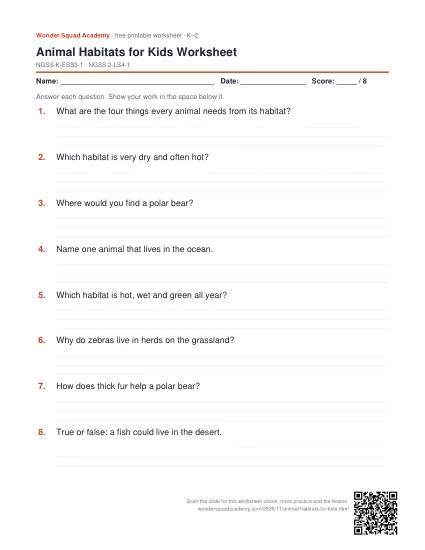
📄 Animal Habitats for Kids Worksheet.pdf
⬇ Download PDF🖨 Open & printWorksheet page
🔒 Free parent sign-in (Google or Microsoft) to download. Why?
Common mistakes and quick fixes
- Thinking a habitat is just a house. A habitat is a whole area, like a forest or a pond, not one nest or burrow. The nest is the shelter inside the habitat.
- "All deserts are full of sand." Many deserts are rocky, and some, like Antarctica, are cold. A desert is a place with very little rain.
- Mixing up the forest and the rainforest. Ask: does it rain almost every day and stay warm all year? Then it is a rainforest.
Try it at home
Go on a backyard habitat hunt. Walk around a yard or park and look for animal homes: a bird's nest, an ant hill, a spider web, a hole in a tree. For each one, ask: where does this animal get food, water and shelter? Then build a habitat in a shoebox with your child's favorite animal, showing all four things it needs.
Keep exploring: take the continent facts tour to see where these habitats are, watch the Living and Nonliving Things video lesson, or browse all K–2 lessons.
Questions parents ask
What is a habitat in simple words?
A habitat is an animal's natural home. It gives the animal the four things it needs: food, water, shelter and space.
Can an animal live in more than one habitat?
Some can. Raccoons and foxes live in forests and in towns, for example. But many animals are suited to one habitat, like polar bears in the Arctic or camels in the desert.
What happens when a habitat is damaged?
Animals may lose food, water or shelter and have to move or may not survive. That is why protecting forests, wetlands and oceans matters.