What your child learns
- Explain that plants make their own food (sugar) using sunlight, water and carbon dioxide.
- Name what goes in and what comes out of photosynthesis.
- Identify the leaf, chlorophyll and chloroplasts as the "food factory" parts of a plant.
- Connect photosynthesis to the oxygen we breathe and to food chains.
NGSS 5-LS1-1 NGSS MS-LS1-6
Animals have to find food, but plants make their own. They do it with a process called photosynthesis. "Photo" means light and "synthesis" means putting together: plants use light to put together food.
The recipe
Example 1: What goes in, what comes out
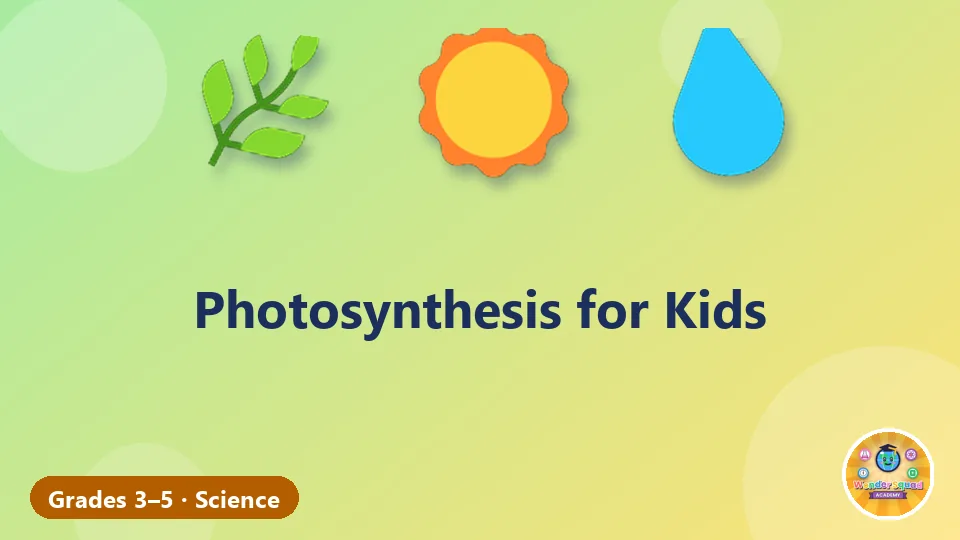
- In: sunlight (energy), water (taken up by the roots) and carbon dioxide (a gas from the air, taken in through tiny holes in the leaves).
- Out: sugar, called glucose (the plant's food), and oxygen (released into the air).
- In words: water + carbon dioxide + sunlight → sugar + oxygen.
Example 2: Inside the leaf
- Leaves are flat and wide, like solar panels, to catch as much sunlight as possible.
- The leaf's cells contain chloroplasts, which hold a green substance called chlorophyll. Chlorophyll captures the Sun's energy.
- Tiny holes on the underside of the leaf, called stomata, let carbon dioxide in and oxygen out.
Example 3: Why it matters to us
- The oxygen plants release is the oxygen people and animals breathe.
- The sugar plants make is the start of every food chain: rabbits eat grass, foxes eat rabbits, and so on.
- So nearly all the energy in our food first came from the Sun, captured by plants.
Practice
- What three things does a plant need for photosynthesis?
- What gas do plants give off during photosynthesis?
- What gas do plants take in from the air?
- What is the green substance in leaves that captures sunlight?
- What kind of food does a plant make?
- Which part of the plant takes in water from the soil?
- What does "photo" mean in "photosynthesis"?
- Why do plants kept in a dark closet grow weak and pale?
Show answers
- Sunlight, water and carbon dioxide
- Oxygen
- Carbon dioxide
- Chlorophyll
- Sugar (glucose)
- The roots
- Light
- Without light they cannot make enough food by photosynthesis.
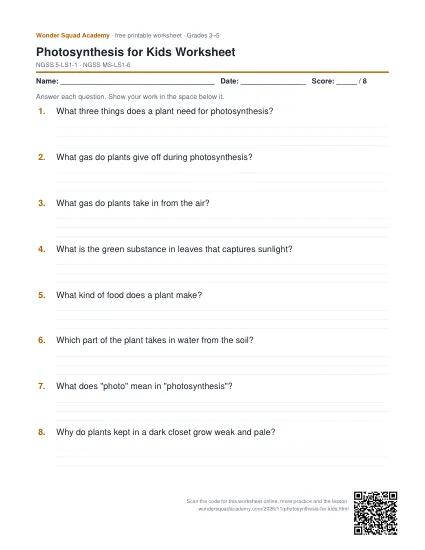
📄 Photosynthesis for Kids Worksheet.pdf
⬇ Download PDF🖨 Open & printWorksheet page
🔒 Free parent sign-in (Google or Microsoft) to download. Why?
Common mistakes and quick fixes
- "Plants eat soil." A famous experiment by Jan van Helmont in the 1600s grew a willow tree for five years: the tree gained more than 70 kg, but the soil lost only a tiny amount. Most of the plant's mass came from air and water.
- "Plants make oxygen and people make carbon dioxide, so plants don't use oxygen." Plants use oxygen too, all the time; they just make more than they use in daylight.
- Thinking photosynthesis happens at night. It needs light, so it happens in the daytime.
Try it at home
Try the bubbling leaf experiment. Put a fresh green leaf in a clear glass of water and place it in bright sunshine. After an hour or two, look closely: tiny bubbles appear on the leaf. Those are bubbles of gas, including oxygen, made during photosynthesis. Compare with a leaf in a glass kept in a dark cupboard.
Keep exploring: learn about plant and animal cells and their chloroplasts, review the plant life cycle, or browse all Grades 3–5 lessons.
Questions parents ask
Do plants get their food from the soil?
Not their main food. Plants take in water and small amounts of minerals from the soil, but most of the material a plant is made of comes from carbon dioxide in the air, joined with water using the Sun's energy.
Why are leaves green?
Leaves are full of a green substance called chlorophyll, found inside tiny parts of the cells called chloroplasts. Chlorophyll captures sunlight for photosynthesis and reflects green light, so we see leaves as green.
Do plants breathe?
Yes, in a way. Like animals, plants use oxygen to release energy from their food (respiration) day and night. During the day, photosynthesis makes much more oxygen than the plant uses, so plants give oxygen to the air.