What your child learns
- Explain that the Moon does not make light; it reflects light from the Sun.
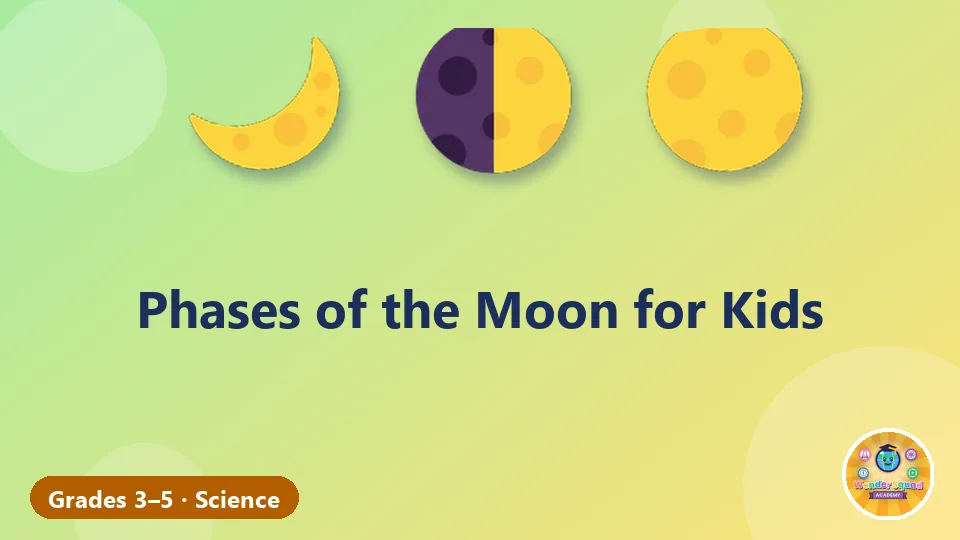
- Name the 8 phases of the Moon in order, from new moon to full moon and back.
- Use the words waxing (the lit part is growing) and waning (the lit part is shrinking).
- Use a model to show why the phases happen and predict the next phase.
NGSS 1-ESS1-1 NGSS MS-ESS1-1
Look at the Moon a few nights in a row and it seems to change shape: a thin smile, then a half circle, then a bright full circle. The Moon itself never changes. What changes is how much of its sunny side we can see from Earth as it travels around us.
Half lit, all the time
The Sun always lights up half of the Moon, the half facing the Sun, just like it lights up half of Earth to make daytime. The Moon goes around Earth about once every 29½ days. As it moves, we look at that lit half from a different angle each night.
Example 1: New moon to full moon
- New moon: the Moon is between Earth and the Sun. Its lit side faces away from us, so we see almost nothing.
- Waxing crescent: a thin sliver of light appears and grows each night.
- First quarter: about a week after the new moon, we see half of the Moon lit.
- Waxing gibbous: more than half is lit, and still growing.
- Full moon: Earth is between the Sun and the Moon, so we see the whole lit side as a bright circle.
Example 2: Full moon back to new moon
- Waning gibbous: the lit part starts to shrink.
- Third quarter (also called last quarter): half is lit again, but the other half.
- Waning crescent: a thin sliver that gets thinner each night.
- Then it is a new moon again, and the cycle repeats.
So there are 8 phases: new, waxing crescent, first quarter, waxing gibbous, full, waning gibbous, third quarter and waning crescent.
Example 3: Predict the next phase
Tonight the Moon is a first quarter (half lit). What will it look like in about a week?
- First quarter comes after the new moon, so the lit part is growing (waxing).
- Next comes waxing gibbous, then full moon.
- From first quarter to full moon is about a week, so in a week it will be close to full.
A memory trick
In the Northern Hemisphere, a waxing Moon is lit on the right side, and a waning Moon is lit on the left. Think "light on the right, getting bright". (South of the equator it is the other way around.)
Practice
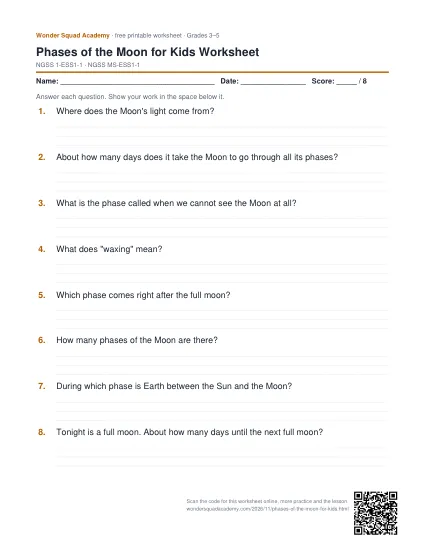
- Where does the Moon's light come from?
- About how many days does it take the Moon to go through all its phases?
- What is the phase called when we cannot see the Moon at all?
- What does "waxing" mean?
- Which phase comes right after the full moon?
- How many phases of the Moon are there?
- During which phase is Earth between the Sun and the Moon?
- Tonight is a full moon. About how many days until the next full moon?
Show answers
- From the Sun; the Moon reflects sunlight.
- About 29½ days
- New moon
- The lit part is growing each night.
- Waning gibbous
- 8
- Full moon
- About 29½ days (about 30)
📄 Phases of the Moon for Kids Worksheet.pdf
⬇ Download PDF🖨 Open & printWorksheet page
🔒 Free parent sign-in (Google or Microsoft) to download. Why?
Common mistakes and quick fixes
- "Earth's shadow makes the phases." Earth's shadow only reaches the Moon during a lunar eclipse. Phases come from the angle we see the sunlit half from. The lamp-and-ball model below shows this clearly.
- "The Moon only comes out at night." The Moon is often visible during the day, especially around the first and third quarter phases.
- Mixing up waxing and waning. Waxing = growing (think of a candle's wax building up); waning = shrinking.
Try it at home
Build a Moon model. In a dark room, set a lamp without its shade on a table (the Sun). Your child holds a ball or an orange at arm's length (the Moon); their head is Earth. As they turn slowly in a circle, the lit part of the ball changes from a thin crescent to half to full and back, exactly like the real phases. For a tasty version, scrape cream from sandwich cookies to make all 8 phase shapes.
Keep exploring space: take the planet-by-planet facts tour, watch the Solar System video lesson, or browse all Grades 3–5 lessons.
Questions parents ask
Does the Moon make its own light?
No. The Moon is a rock that reflects sunlight, like a mirror bouncing a flashlight beam. The bright part of the Moon is the side lit by the Sun.
Is the Earth's shadow what makes the phases?
No, that is a very common mix-up. Phases happen because we see different amounts of the Moon's sunlit half as it travels around Earth. Earth's shadow only falls on the Moon during a lunar eclipse.
How long does it take to go through all the phases?
About 29½ days, roughly one month. In fact, the word "month" comes from the word "moon".