What your child learns
- Break two-digit numbers into tens and ones to multiply them.
- Use an area model and partial products to find answers like 23 × 14.
- Connect the area model to the standard written method.
- Estimate first to check that an answer makes sense.
Common Core 4.NBT.B.5
Multiplying 23 × 14 looks hard until you notice it is really four easy facts in disguise. The trick is place value: 23 is 20 + 3, and 14 is 10 + 4. Multiply every part by every part, then add.
The area model
Example 1: 23 × 14
- Split the numbers: 23 = 20 + 3 and 14 = 10 + 4.
- Draw a rectangle with 2 columns (20 and 3) and 2 rows (10 and 4).
- Fill in each box: 20 × 10 = 200, 3 × 10 = 30, 20 × 4 = 80, 3 × 4 = 12.
- Add the four partial products: 200 + 30 + 80 + 12 = 322.
Estimate check: 23 × 14 is between 20 × 10 = 200 and 25 × 15 = 375, so 322 is reasonable.
Example 2: 36 × 27
- Split: 36 = 30 + 6 and 27 = 20 + 7.
- Partial products: 30 × 20 = 600, 6 × 20 = 120, 30 × 7 = 210, 6 × 7 = 42.
- Add: 600 + 120 + 210 + 42 = 972.
The standard method
Example 3: 23 × 14, written the short way
- Multiply 23 by the ones digit, 4: 4 × 3 = 12 (write 2, carry 1), 4 × 2 = 8, plus the carried 1 = 9. First row: 92.
- Multiply 23 by the tens digit, which is really 10: write a 0 in the ones place, then 1 × 23 = 23. Second row: 230.
- Add the rows: 92 + 230 = 322.
Notice the rows match the area model: 92 = 80 + 12 (the "4" row) and 230 = 200 + 30 (the "10" row).
Practice
- 12 × 13 = ?
- 21 × 15 = ?
- 14 × 14 = ?
- 32 × 11 = ?
- 25 × 16 = ?
- 43 × 22 = ?
- A classroom has 18 rows of 12 chairs. How many chairs?
- Each box holds 24 crayons. How many crayons are in 15 boxes?
Show answers
- 156
- 315
- 196
- 352
- 400
- 946
- 216
- 360
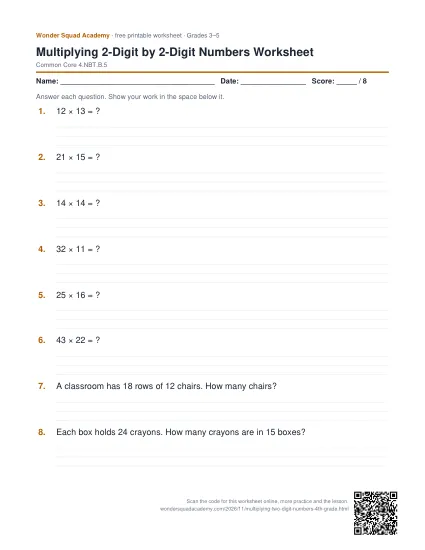
📄 Multiplying 2-Digit by 2-Digit Numbers Worksheet.pdf
⬇ Download PDF🖨 Open & printWorksheet page
🔒 Free parent sign-in (Google or Microsoft) to download. Why?
Common mistakes and quick fixes
- Multiplying only tens by tens and ones by ones (23 × 14 = 200 + 12 = 212). Every part must be multiplied by every part: four boxes, four products.
- Forgetting the zero in the second row of the standard method. Say it out loud: "Now I'm multiplying by ten."
- Adding mistakes at the end. Line up the partial products by place value before adding.
Try it at home
Use graph paper. Outline a 13-by-12 rectangle and count how many squares are inside by splitting it into a 10-by-10 block, a 3-by-10 block, a 10-by-2 block and a 3-by-2 block. (100 + 30 + 20 + 6 = 156.) Then check with the standard method. Real-life version: "Tickets are $15 each and 12 of us are going. What is the total?"
This guide matches the multiplication unit in Level Up Math, Grade 4 (coming January 2027). Review the basics in the Multiplication for Kids video lesson, explore splitting numbers with the place value blocks, or browse all Grades 3–5 lessons.
Questions parents ask
Should my child learn the area model or the standard algorithm?
Both, in that order. The area model shows why multiplication works by splitting numbers into tens and ones. The standard algorithm is a fast, compact way to write the same steps. Common Core asks 4th graders to use strategies like area models; the standard algorithm becomes the expected method in 5th grade.
Why do we write a zero in the second row of the standard method?
Because the second row multiplies by the tens digit. In 23 × 14, the 1 in 14 really means 10, so 23 × 10 = 230. The zero holds the ones place.
How can my child check a multiplication answer?
Estimate first: round each number to the nearest ten and multiply. 23 × 14 is close to 20 × 10 = 200 and 25 × 15 = 375, so an answer of 322 makes sense.