What your child learns
- Explain why fractions need a common denominator before adding or subtracting.
- Find a common denominator and rewrite fractions as equivalent fractions.
- Add and subtract fractions and mixed numbers with unlike denominators, and simplify.
- Estimate with benchmark fractions (0, 1/2, 1) to check answers.
Common Core 5.NF.A.1 Common Core 5.NF.A.2
In 4th grade, children add fractions with the same denominator: 2/8 + 3/8 = 5/8. In 5th grade the denominators are different, like 1/2 + 1/3. The big idea: you can only add pieces of the same size, so first rename the fractions so the pieces match.
The three steps
Find a common denominator → rewrite each fraction → add or subtract the numerators.
Example 1: 1/2 + 1/3
- Common denominator: a number both 2 and 3 divide into. 6 works.
- Rewrite: 1/2 = 3/6 and 1/3 = 2/6.
- Add the numerators: 3/6 + 2/6 = 5/6.
See it with the fraction bars tool: a half lines up with three sixths.
Example 2: 3/4 − 1/6
- Multiples of 4: 4, 8, 12. Multiples of 6: 6, 12. Use 12.
- Rewrite: 3/4 = 9/12 and 1/6 = 2/12.
- Subtract: 9/12 − 2/12 = 7/12.
Example 3: An answer to simplify
- 2/3 + 1/6. Use 6 as the common denominator: 2/3 = 4/6.
- 4/6 + 1/6 = 5/6. That is already in simplest form.
- Now try 1/4 + 5/12: 3/12 + 5/12 = 8/12, which simplifies to 2/3 (divide top and bottom by 4).
Mixed numbers and word problems
Example 4: 2 1/2 + 1 2/3
- Add the whole numbers: 2 + 1 = 3.
- Add the fractions: 1/2 + 2/3 = 3/6 + 4/6 = 7/6 = 1 1/6.
- Combine: 3 + 1 1/6 = 4 1/6.
Example 5: A recipe
- "A recipe uses 3/4 cup of flour and 1/3 cup of sugar. How much more flour than sugar?"
- Subtract: 3/4 − 1/3 = 9/12 − 4/12 = 5/12.
- There is 5/12 cup more flour. Estimate check: about 3/4 − 1/4 = 1/2, close to 5/12 (6/12 would be exactly 1/2).
Practice
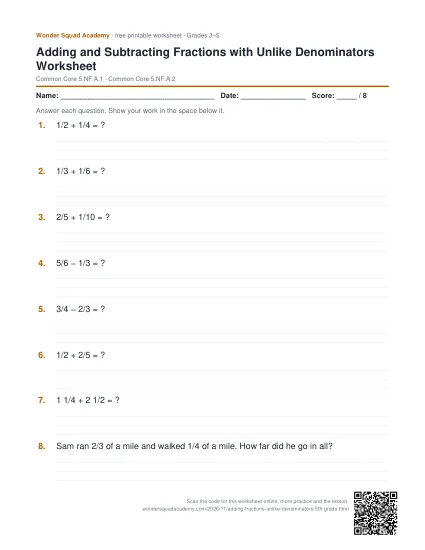
- 1/2 + 1/4 = ?
- 1/3 + 1/6 = ?
- 2/5 + 1/10 = ?
- 5/6 − 1/3 = ?
- 3/4 − 2/3 = ?
- 1/2 + 2/5 = ?
- 1 1/4 + 2 1/2 = ?
- Sam ran 2/3 of a mile and walked 1/4 of a mile. How far did he go in all?
Show answers
- 3/4
- 1/2 (3/6 simplified)
- 1/2 (5/10 simplified)
- 1/2 (3/6 simplified)
- 1/12
- 9/10
- 3 3/4
- 11/12 of a mile
📄 Adding and Subtracting Fractions with Unlike Denominators Worksheet.pdf
⬇ Download PDF🖨 Open & printWorksheet page
🔒 Free parent sign-in (Google or Microsoft) to download. Why?
Common mistakes and quick fixes
- Adding the denominators (1/2 + 1/3 = 2/5). Ask: is 2/5 bigger than 1/2? It should be, but it is not, so something went wrong.
- Changing the denominator but not the numerator. Whatever you multiply the bottom by, multiply the top by the same number.
- Forgetting to simplify or to change an improper fraction like 7/6 into 1 1/6.
Try it at home
Cook with measuring cups. Ask questions like "We need 1/2 cup and then 1/4 cup more. How much in all?" and let your child check by pouring water or rice into the 1/4 cup scoop. Measuring makes common denominators real: two 1/4 cups fill one 1/2 cup.

This guide matches the fractions unit in Level Up Math, Grade 5 (coming January 2027). Review fraction basics in the Fractions for Kids lesson, or browse all Grades 3–5 lessons.
Questions parents ask
Why can't we just add the tops and the bottoms?
Because the denominator names the size of the pieces. 1/2 + 1/3 adds halves and thirds, which are different sizes. First rewrite them as the same size pieces (sixths): 3/6 + 2/6 = 5/6. Adding tops and bottoms (2/5) would give an answer smaller than 1/2, which cannot be right.
Do we have to use the least common denominator?
No. Any common denominator works. The least one keeps the numbers small, but multiplying the two denominators always works too; just simplify at the end.
How can my child check an answer?
Estimate with benchmarks. 1/2 + 3/8 is a bit less than 1/2 + 1/2 = 1, so an answer of 7/8 makes sense.