What your child learns
- Find a percent increase or decrease from an original amount to a new amount.
- Calculate sale prices, sales tax, tips and markups.
- Use the multiplier shortcut (for example, × 0.85 for 15% off).
- Check answers with estimation.
Common Core 7.RP.A.3 Common Core 7.EE.B.3
Percents describe change in real life: prices on sale, tax at the register, a growing allowance. Every problem on this page uses the same key idea: a percent is always a percent of something, so first ask "percent of what?"
Percent of change
Percent change = amount of change ÷ original amount × 100.
Example 1: An increase
- A plant grows from 40 cm to 50 cm.
- Change: 50 − 40 = 10 cm.
- 10 ÷ 40 = 0.25 = 25% increase. Always divide by the original amount.
Example 2: A decrease
- A video game drops from $60 to $45.
- Change: 60 − 45 = 15.
- 15 ÷ 60 = 0.25 = 25% decrease.
Money problems
Example 3: Discount
- A $80 jacket is 15% off.
- Shortcut: you pay 100% − 15% = 85% of the price.
- 0.85 × 80 = $68. (Check: 15% of 80 = 12, and 80 − 12 = 68.)
Example 4: Sales tax
- A $24 book with 8% sales tax.
- Multiplier: 100% + 8% = 108% = 1.08.
- 1.08 × 24 = $25.92.
Example 5: Tip
- A $35 restaurant bill with an 18% tip.
- 10% of 35 = 3.50; 8% = 2.80 (since 1% = 0.35). Tip = 3.50 + 2.80 = $6.30.
- Total: 35 + 6.30 = $41.30.
Practice
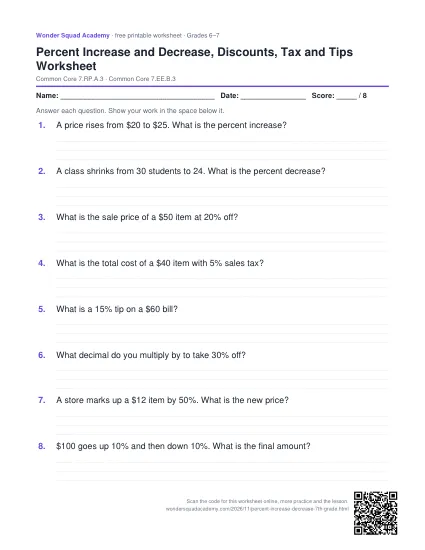
- A price rises from $20 to $25. What is the percent increase?
- A class shrinks from 30 students to 24. What is the percent decrease?
- What is the sale price of a $50 item at 20% off?
- What is the total cost of a $40 item with 5% sales tax?
- What is a 15% tip on a $60 bill?
- What decimal do you multiply by to take 30% off?
- A store marks up a $12 item by 50%. What is the new price?
- $100 goes up 10% and then down 10%. What is the final amount?
Show answers
- 25%
- 20%
- $40
- $42
- $9
- 0.7
- $18
- $99
📄 Percent Increase and Decrease, Discounts, Tax and Tips Worksheet.pdf
⬇ Download PDF🖨 Open & printWorksheet page
🔒 Free parent sign-in (Google or Microsoft) to download. Why?
Common mistakes and quick fixes
- Dividing by the new amount instead of the original. "Percent of change" is always compared with where you started.
- Stopping at the discount (15% off $80 = $12) instead of the sale price ($68).
- Thinking +10% then −10% cancels out. The second percent is of a different number.
Try it at home
Go on a receipt hunt. Look at a real grocery or restaurant receipt together. Find the subtotal, the tax, and calculate what percent the tax was. At a restaurant, let your child work out a 15% and a 20% tip using the 10% trick.
This guide matches the percents unit in Level Up Math, Grade 7 (coming January 2027). Review the basics with Ratios and Percents Explained, or browse all Grades 6–7 lessons.
Questions parents ask
How do you find the percent of change?
Subtract to find the amount of change, then divide by the original amount and multiply by 100. From 50 to 60, the change is 10, and 10 ÷ 50 = 0.2 = 20%.
Is a 20% discount the same as paying 80%?
Yes. Taking off 20% leaves 80% of the price, so you can multiply by 0.80 in one step.
If a price goes up 10% and then down 10%, is it back where it started?
No. The decrease is 10% of a bigger number. $100 up 10% is $110, and 10% off $110 is $99.