What your child learns
- Compare two groups of up to 10 objects by matching or counting.
- Use the words more, fewer and the same (equal).
- Compare two written numbers from 1 to 10 and say which is greater or less.
Common Core K.CC.C.6 Common Core K.CC.C.7
Comparing is one of the first big ideas in math. Before children can add or subtract, they need to see that 7 is more than 5 and that 3 is fewer than 6. Start with real objects your child can touch and move, then move to pictures, and finally to numbers on their own.
Comparing groups
There are two good ways: match the objects, or count them.
Example 1: Match one to one
- Put 5 red blocks in a row. Put 3 blue blocks in a row underneath.
- Push one blue block next to each red block.
- 2 red blocks have no partner, so there are more red blocks, and fewer blue blocks.
Matching works even before a child can count well.
Example 2: Count each group
- Count the apples: 1, 2, 3, 4, 5, 6. There are 6 apples.
- Count the pears: 1, 2, 3, 4. There are 4 pears.
- 6 comes after 4 when we count, so there are more apples.
Example 3: The same
- 4 cats and 4 dogs.
- Match each cat with a dog. Nothing is left over.
- The groups are the same (equal).
Comparing numbers
When counting gets easy, compare the numbers themselves.
Example 4: Which number is greater?
- Compare 8 and 6.
- Count up: 6 comes first, then 7, then 8.
- The number we say later is greater: 8 is greater than 6.
Practice with the online number line: the greater number is always farther to the right.
Practice
- Which group has more: 5 apples or 3 apples?
- Which number is fewer: 7 or 9?
- There are 4 cats and 4 dogs. Are there more cats, more dogs, or the same?
- Which number is greater: 8 or 6?
- Which number is less: 2 or 10?
- Sam has 6 stickers and Ana has 4. Who has more?
- Is 3 more than or less than 7?
- Group A has ★★★★ and group B has ★★★★★★. Which group has more stars?
Show answers
- 5 apples
- 7
- The same
- 8
- 2
- Sam
- Less than
- Group B (6 stars)
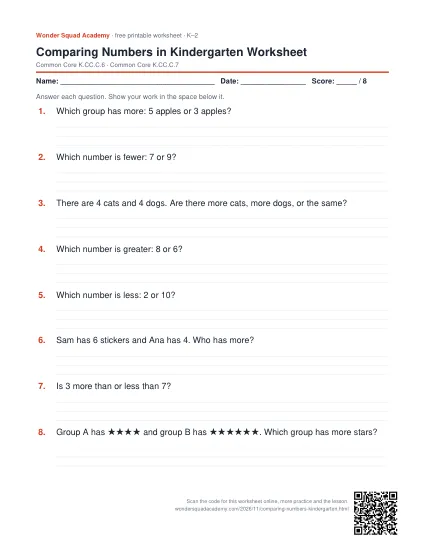
📄 Comparing Numbers in Kindergarten Worksheet.pdf
⬇ Download PDF🖨 Open & printWorksheet page
🔒 Free parent sign-in (Google or Microsoft) to download. Why?
Common mistakes and quick fixes
- Judging by size, not number. 3 big balls can look like "more" than 5 small ones. Match or count instead of looking.
- Mixing up "fewer" and "more". Ask: "Which group has some left over when we match?" That group has more.
- Counting the same object twice. Move each object as you count it, or touch each one once.
Try it at home
Play snack compare. Put a few crackers in two piles. Your child guesses which pile has more, then checks by matching crackers one to one. Swap roles: your child makes the piles and you guess. Try making two piles that are the same.
This guide matches the comparing numbers unit in Level Up Math, Kindergarten (coming January 2027). Print the free comparing numbers worksheet, start with counting to 10, or browse all K–2 lessons.
Questions parents ask
How do kindergartners compare two groups?
First by matching: line the objects up one to one and see which group has some left over. Later by counting each group and comparing the two numbers.
Should kindergartners use the > and < signs?
Not yet. Common Core introduces the symbols in 1st grade. In kindergarten children use the words greater than, less than, more, fewer and the same.
What does 'the same' mean when comparing?
Both groups have an equal number of objects. If you match them one to one, nothing is left over.