What your child learns
- Add within 20 using three strategies: count on, doubles and make a ten.
- Solve addition story problems by drawing or writing a number sentence.
- Know that numbers can be added in any order (3 + 9 = 9 + 3).
Common Core 1.OA.A.1 Common Core 1.OA.C.6
In kindergarten, children add by counting everything. In 1st grade they learn faster ways, because counting every object gets slow once sums go past 10. Each strategy below uses something your child already knows to find something new.
Three strategies
Example 1: Count on from the bigger number
- Add 3 + 9. Switch the order so the bigger number is first: 9 + 3 (the answer is the same).
- Say "9" and count on 3: 10, 11, 12.
- So 3 + 9 = 12.
Example 2: Use a double
- Add 6 + 7.
- You know the double 6 + 6 = 12.
- 7 is one more than 6, so 6 + 7 is one more than 12: 13.
This is called "doubles plus one".
Example 3: Make a ten
- Add 8 + 5.
- 8 needs 2 more to make 10. Split 5 into 2 and 3.
- 8 + 2 = 10, then 10 + 3 = 13.
Try it on the online ten frames: fill the first frame, then see what spills into the second.
Story problems
Read the story, draw it or picture it, then write a number sentence.
Example 4: Two groups
- "There are 9 ducks in the pond. 6 more ducks land. How many ducks now?"
- Two groups put together: 9 + 6.
- Make a ten: 9 + 1 = 10, then 10 + 5 = 15 ducks.
Practice
- 7 + 4 = ?
- 5 + 5 = ?
- 5 + 6 = ?
- 9 + 7 = ?
- 8 + 8 = ?
- 2 + 11 = ?
- Maya has 8 stickers and gets 4 more. How many stickers does she have?
- There are 6 red cars and 9 blue cars. How many cars in all?
Show answers
- 11
- 10
- 11
- 16
- 16
- 13
- 12
- 15
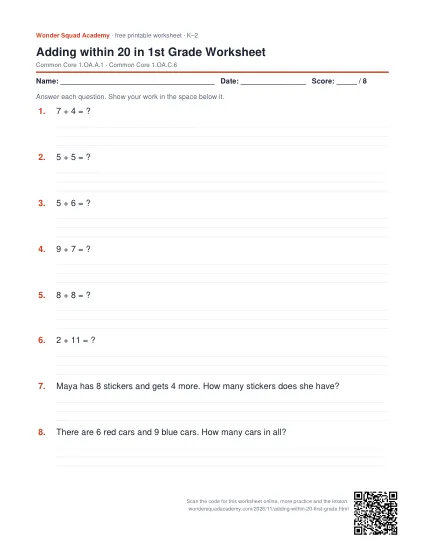
📄 Adding within 20 in 1st Grade Worksheet.pdf
⬇ Download PDF🖨 Open & printWorksheet page
🔒 Free parent sign-in (Google or Microsoft) to download. Why?
Common mistakes and quick fixes
- Counting the start number again when counting on (9 + 3 → "9, 10, 11"). Say the first number, then start counting with the next one.
- Always counting from 1. Encourage starting from the bigger number; it is faster and leads to fewer mistakes.
- Splitting the wrong number in make a ten. Fill up the number closest to 10: for 8 + 5, make the 8 into 10.
Try it at home
Play make-ten card flip. Remove face cards from a deck. Flip two cards and add them. Your child says the strategy they used ("make a ten!", "doubles plus one!"). Whoever has the bigger sum keeps both cards. Count your cards at the end, counting on by twos or tens.
This guide matches the addition and subtraction unit in Level Up Math, Grade 1 (coming January 2027). Watch the Adding to 10 video lesson for a warm-up, or browse all K–2 lessons.
Questions parents ask
Should my 1st grader still count on fingers?
Fingers are a fine tool while learning. The goal by the end of 1st grade is to add within 10 quickly and to use strategies like make a ten for bigger sums, so fingers gradually become less necessary.
What is the make-a-ten strategy?
It means breaking a number apart to fill up a ten first. For 8 + 5, take 2 from the 5 to make 8 + 2 = 10, then add the 3 left over: 10 + 3 = 13.
How many addition facts should a 1st grader know by heart?
Common Core asks 1st graders to add and subtract within 20 using strategies, and to be fluent (quick and accurate) within 10. Full fluency within 20 is a 2nd grade goal.